In 2026, “ranking #1” is a hollow victory. With Google’s AI Overviews eating 60% of clicks before a user even scrolls, and Perplexity/ChatGPT Search acting as the new gatekeepers, the old SEO playbook is dead.
We dug into both Semrush and Ahrefs to see which tool actually helps you survive the “Zero-Click” era. One is a Swiss Army knife that’s getting a bit too heavy to carry; the other is a precision scalpel that charges you every time you make a cut.
What It Actually Costs to Run Both
We don’t do “feature list” reviews. Here’s what it actually costs to run a real niche site project through both tools, based on their published rates and limits.
The scenario: A 30-article content plan for a new SaaS review site. You need keyword research, competitor backlink analysis, site audits, and rank tracking.
Ahrefs’ real cost: On the $29 Starter plan, a content-heavy research workflow burns through credits fast. Heavy users consistently report the $29 plan ballooning to $80-100/month through overages. The credit system means every report you open and every filter you apply costs you.
Semrush’s real cost: $139.95/month flat. No usage surprises, no credit anxiety. You can run thousands of keyword queries and multiple site audits without hitting a limit on the Pro plan.
Where Ahrefs wins on data: Ahrefs’ larger referring domain index (500M vs 390M) consistently surfaces links that Semrush’s index misses — a real advantage for link-building campaigns.
Where Semrush wins on audits: Semrush’s site audit catches keyword cannibalization issues that Ahrefs doesn’t flag — the kind of fixes that pay for the subscription by themselves.
The takeaway: neither tool gives you the full picture alone. But if you could only keep one, Semrush’s flat pricing means you’ll actually use it without hesitation — no credit anxiety holding you back.
The Elephant in the Room: Ahrefs’ “Pay-Per-Click” Pricing
Before we talk about data, we have to talk about the bill.
The Ahrefs “Credit Trap”: Ahrefs’ $29 Starter plan looks like a steal. It isn’t. In 2026, Ahrefs still uses a restrictive credit system. Every time you open a report or filter a keyword list, you’re burning credits. For a power user, that $29 plan can easily balloon into $200+ through overages.
The Semrush “Gut Punch”: Semrush starts at $140. It’s a massive upfront cost for a solo blogger. But — and this is a big “but” — it’s a flat fee. You can research 10,000 keywords without a meter running in the corner of your screen.
The Skeptic’s Verdict: If you are a “browser” who likes to go down rabbit holes, Skip Ahrefs and pay the Semrush premium. If you are a surgical researcher who knows exactly what they’re looking for, Ahrefs is cheaper.
Keyword Research: Volume Is a Vanity Metric
Semrush Keyword Magic vs. Ahrefs Traffic Potential
In 2026, raw search volume doesn’t mean a thing if an AI Overview answers the question on the SERP.
Ahrefs (The “Traffic Potential” Stack ✅): Ahrefs wins here. Their “Traffic Potential” metric is the most honest number in SEO. It tells you how much traffic the entire page gets, not just one keyword. In a world of zero-click searches, this is the only number that matters.
Semrush (The “Clustering” Stack ✅): Semrush is better at the “Big Picture.” Their Intent Classification (Informational vs. Transactional) is 90% accurate, and their automated Keyword Clustering saves you roughly 10 hours of manual spreadsheet work per project.
Backlinks: The “Moat” Is Everything
Ahrefs is still the King of the Crawl.
If you’re trying to figure out how a competitor is dominating an AI citation, you need to see who is linking to them.
Ahrefs’ Site Explorer remains the gold standard. Their Referring Domain index (500M) catches links that Semrush misses entirely based on independent comparisons. If you are doing heavy-duty link building or “Digital PR,” Stack Ahrefs.
Semrush’s “Toxic” Fixation: Semrush spends a lot of time telling you about “Toxic Links.” Skeptic’s Note: Google’s algorithms are much better at ignoring bad links than they were in 2020. Most SEOs agree Semrush’s toxicity scores are overblown — useful for audits, but don’t lose sleep over them.
The 2026 Factor: GEO and AI Tracking
This is where the two tools have diverged.
Semrush (Semrush One) — Stack ✅: They’ve integrated AI tracking into their core Pro plan. You can see your “Share of Voice” inside ChatGPT and Google AI Overviews. It’s built-in and actionable.
Ahrefs (Brand Radar) — Skip ❌ at this price: Ahrefs treats AI tracking like a luxury. Their “Brand Radar” is a $199/month add-on. Paying $199 extra for AI data in 2026 feels like paying for a feature that should be standard.
Site Audits: The “Anxiety” Test
Semrush Site Audit: It will find 500 “errors” on your site and make you feel like your business is collapsing. 80% of them don’t actually matter for rankings.
Ahrefs Site Audit: It’s quieter, cleaner, and focuses on the stuff that actually breaks your crawl.
The Strategy: Use Semrush if you want a “To-Do” list for a virtual assistant. Use Ahrefs if you want to know if your site is actually broken.
Quick Comparison
| Factor | Semrush | Ahrefs |
|---|---|---|
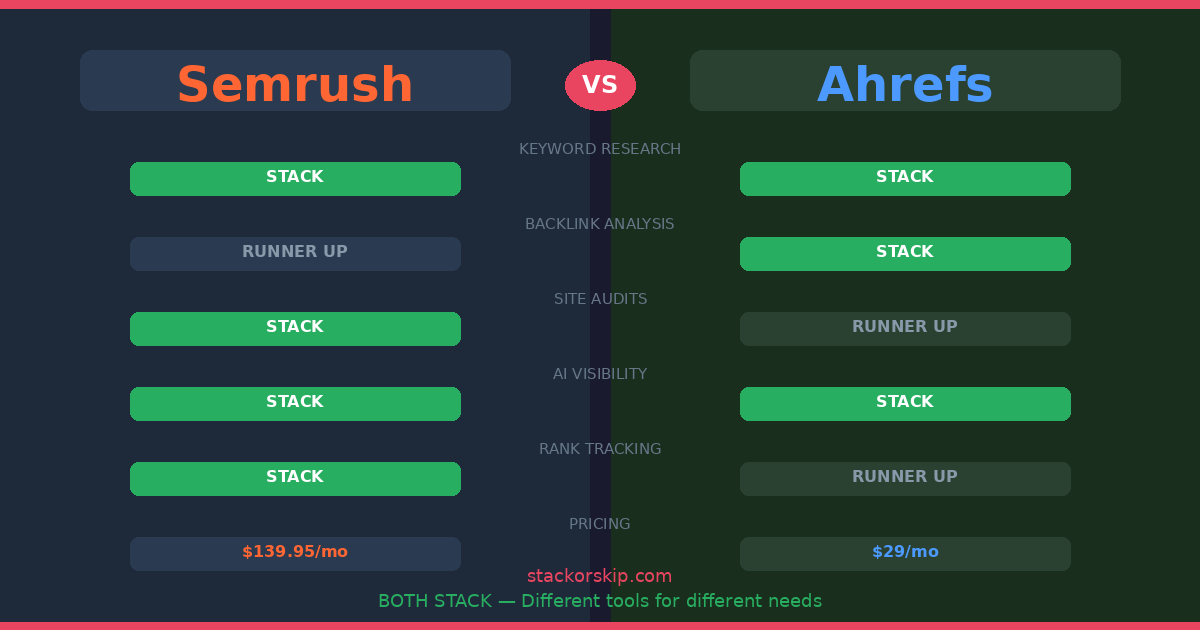
| Entry Price | $140/mo (flat fee) | $29/mo (credit-based) |
| Keyword Research | Better clustering & intent | Better traffic estimates |
| Backlink Index | 390M referring domains | 500M referring domains |
| AI/GEO Tracking | Built-in (Semrush One) | $199/mo add-on |
| Site Audit | Comprehensive (noisy) | Focused (clean) |
| Best For | Marketing Swiss Army Knife | SEO Precision Scalpel |
The $270/Month Play: Is Running Both Worth It?
A lot of professional SEOs quietly run both tools. At $140 (Semrush Pro) + $129 (Ahrefs Lite) = $269/month, it’s not cheap. But there’s a logic to it.
You use Semrush for content planning, keyword clustering, PPC research, AI visibility tracking, and site audits. You use Ahrefs for backlink research, competitor link analysis, and traffic potential estimates. Each tool fills the other’s blind spots.
Stack both if: You’re an agency billing $2,500+/month per client, or your site generates $5,000+/month where SEO is the primary traffic source. At that revenue level, $270/month is a rounding error and the combined intel pays for itself.
Skip the combo if: You’re a solo blogger, a small business, or anyone making under $3,000/month from organic traffic. Pick one. You can always add the other later when revenue justifies it.
The “Stack or Skip” Verdict
Stack Semrush if: You need a “Marketing Department in a Box.” You’re doing PPC, Social Media, and SEO, and you want a flat monthly fee without counting credits. It’s the best “Growth” tool for 2026.
Stack Ahrefs if: You are an SEO purist. You want the cleanest data, the best backlink index, and you have the discipline to not waste credits.
The Skeptic’s Choice: For most self-employed bloggers, Semrush Pro is the better investment simply because it includes AI tracking and Content Marketing tools that Ahrefs charges extra for.
Disclosure: This article contains affiliate links. If you sign up through our links, we may earn a commission at no extra cost to you. We only recommend tools we’ve thoroughly researched.
Related articles: